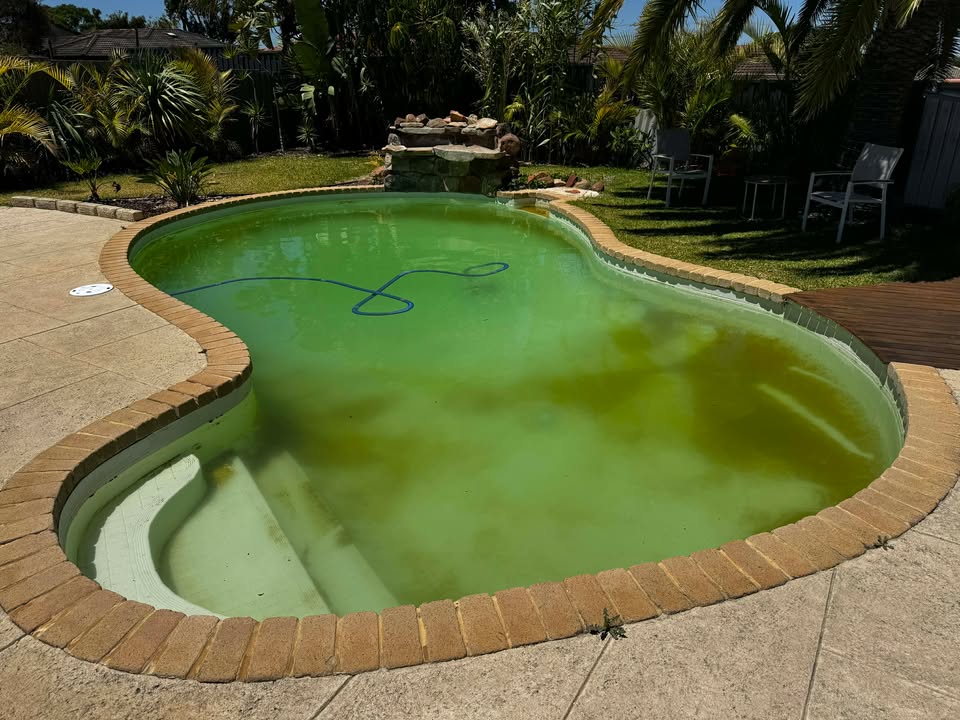

Why Perth pools go green in February
Every year, around the first week of February, our phone starts ringing with the same story. The pool was fine. Then it wasn’t. Now it’s green, and nobody’s quite sure what happened.

After 12 years of looking after Perth pools, we can tell you it’s not bad luck. February green pools happen for predictable reasons. Which is good news, because predictable things can be prevented.
The Perth sun is eating your chlorine
Chlorine is what keeps algae out of your pool. The problem is that UV light destroys chlorine, and February in Perth is about as UV-heavy as it gets anywhere on Earth. A chlorine level that lasted all week in July can disappear in a day or two in February.
Warm water makes it worse. Algae grows faster in a 30-degree pool, so you need more chlorine right when the sun is destroying it fastest. It’s a pincer movement, and your pool is in the middle.
Pumps fail quietly, not loudly
A pump rarely dies with a bang. More often it loses prime, trips a breaker overnight, or the timer drops its settings after a power blip. The pool looks fine for a few days while the chlorinator does nothing, and then it doesn’t.
The other quiet killer is run time. Plenty of Perth pools are still on their winter timer settings in February. Four hours a day might be fine in August. In summer, most pools need eight or more. If the water isn’t moving and the chlorinator isn’t running long enough, algae gets a head start.
The Bali factor
We call it the classic: two weeks in Bali, came home to a swamp. Nobody was topping up the chlorine, nobody noticed the pump had stopped, and a Perth summer needs about four unsupervised days to turn a pool. Two weeks is plenty.
What’s actually happening when a pool turns green
No jargon, promise. Algae spores are always landing in your pool — they blow in on the wind. Chlorine kills them on arrival. When the chlorine runs out, the spores survive, and they multiply fast. One becomes two, two become four, and within a couple of days there are billions.
That’s why a pool seems to go green overnight. It didn’t. It was going green for days — you just couldn’t see it until the numbers got big enough.
How to stop it
- Bump your run time. Eight hours a day minimum through summer, ideally split across the day.
- Test twice a week. You’re aiming for chlorine of 2–3 parts per million. In February, under 1 is a countdown.
- Check stabiliser. It’s the sunscreen for your chlorine. Without enough of it, the sun wins.
- Before you fly out: stand at the pool and watch the pump start on its timer. Then ask a neighbour to glance at the water every few days. A photo text is enough.
Or put the pool on one of our service plans and make it our problem instead. That’s rather the point of them.
Already green? Don’t panic
A green pool looks like a disaster, but it’s almost always fixable. We’ve fixed worse — much worse. Our green pool rescue starts from $450 + GST, and most pools are swim-ready inside 14 days. Many are back sooner.
One thing we’d say: don’t tip a trolley-load of random chemicals in first. It usually makes our job harder and your bill bigger. A water test before anything else saves everyone grief.
If your pool’s gone green — or you’d just like it to never happen — give us a call on (08) 6109 9141. The owner answers the phone, and there are no surprises on the invoice. Your pool, sorted.
Pool gone green?
We’ve fixed worse. Rescues from $450 + GST, most swim-ready in 14 days.
Leave a Reply