• What a $50-a-month pool plan actually covers

    What a $50-a-month pool plan actually covers

    Pool Notes · Service Plans

    What a $50-a-month plan actually covers

    “So what do I actually get for fifty bucks?” Fair question. We get it a lot, and we’d rather answer it properly here than have anyone sign up guessing.

    Sparkling pool on a regular Only Pools and Hoses service plan
    A plan pool, photographed on a routine visit.

    Our plans start at $50 + GST per visit on Bronze, with Gold at $90 and Platinum at $120. Over 140 of our customers are on one. Here’s what each tier actually involves — and just as importantly, what it doesn’t.

    What happens on a Bronze visit

    Bronze is the health check. Every visit, your tech does:

    • A full water test — chlorine, pH, alkalinity, salt, stabiliser and calcium. Six readings, not a quick dip-strip glance.
    • Balance correction — we adjust your chlorinator and dosing settings so the water sits where it should.
    • Baskets emptied — skimmer and pump baskets cleared out.
    • An equipment eyeball — we look over the pump, filter and chlorinator for leaks, odd noises and anything starting to fail. Catching a $30 o-ring before it becomes a $900 pump is most of the value here.
    • A plain-English report — what we found, what we did, what’s worth keeping an eye on. No jargon, no scare tactics.

    What Gold and Platinum add

    Gold ($90 per visit) adds the physical cleaning on top: brushing the walls and waterline, vacuuming, scooping the surface and backwashing the filter when it needs it. The pool isn’t just healthy — it looks the part too.

    Platinum ($120 per visit) is the everything tier: all of the above, with chemicals included. You never buy a bag of salt or a bottle of acid again. One predictable price, and the pool is simply not your problem anymore.

    Why the same tech every visit matters

    It sounds like a nice-to-have. It isn’t. A tech who’s seen your pool twenty times knows your pump’s normal hum, knows your pool drifts acidic after winter, and notices when the water level is 2 centimetres lower than usual — which is how slow leaks get caught early.

    A rotating cast of strangers can follow a checklist. They can’t notice that something’s different. Noticing is the job.

    What’s not included (and why we do it this way)

    On Bronze and Gold, chemicals are charged separately, at cost of what your pool actually used. We could bake an estimate into the price like some companies do — but then everyone with an easy pool quietly overpays to cover everyone with a hard one.

    We’d rather you pay for what your pool needs and see it itemised. It’s a bit less tidy, but it’s honest, and there are no surprises on the invoice. Big repairs are also separate — we’ll always quote before we touch anything.

    Which plan suits who

    • Bronze — you’re happy to scoop leaves and brush walls yourself, but want the chemistry and equipment professionally watched.
    • Gold — you want a clean, healthy pool without doing any of the work, and don’t mind buying the odd bag of salt.
    • Platinum — you want one fixed cost and zero pool admin. Popular with busy families and rental properties.

    If you’re not sure which fits, the details are on our service plans page, or call us on (08) 6109 9141 — the owner answers the phone, and we’re happy to tell you if Bronze is all you need. Your pool, sorted.

    Want it sorted for you?

    Three plans from $50 a visit. Same techs, every time.
  • Heat pump, gas or solar? Heating a Perth pool without the bill shock

    Heat pump, gas or solar? Heating a Perth pool without the bill shock

    Pool Notes · Pool Heating

    Heat pump, gas or solar?

    A heated pool in Perth sounds like a luxury until you realise how short the swimming season actually is without one. Most unheated pools here get used hard from December to March, then sit there looking expensive for eight months.

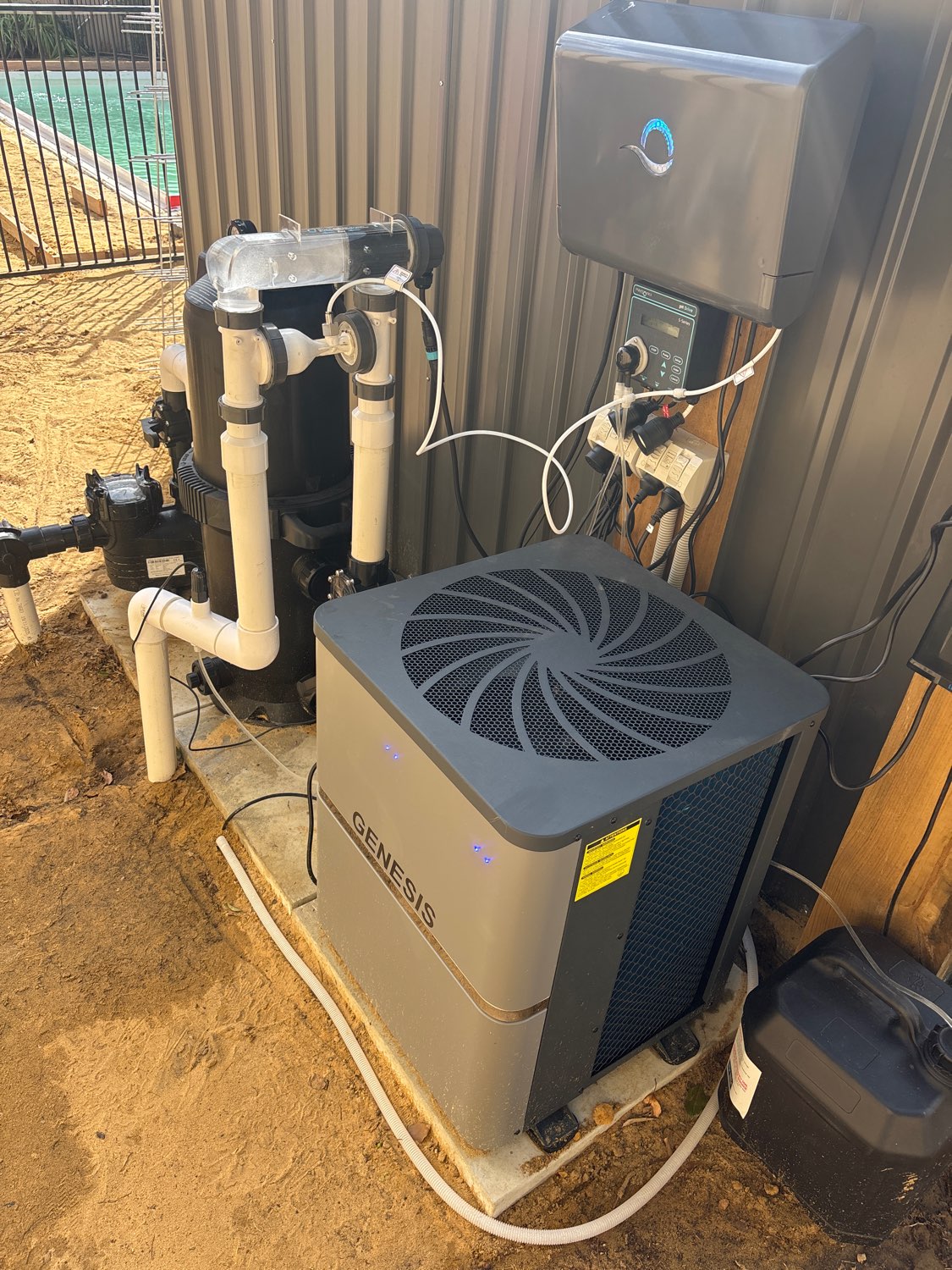
    Heat pump installed by Only Pools and Hoses in Perth
    A recent heat pump install — sized to the pool, not the brochure.

    There are three ways to heat a pool: heat pump, gas, or solar. Each one suits a different household, and the wrong choice is how people end up with bill shock. Here’s the honest version.

    Heat pump: cheapest to run, set and forget

    A heat pump works like an air conditioner in reverse — it pulls warmth out of the air and puts it into your water. That’s why it’s so cheap to run: it’s moving heat, not making it. For every dollar of electricity, you get several dollars’ worth of heat.

    The trade-off is the upfront cost, which is higher than solar and similar to or above gas depending on size. It also heats gradually rather than instantly. But once it’s set, it just holds your pool at temperature without you thinking about it. Most of our heat pump customers swim through Anzac Day, and a fair few keep going past it.

    Gas: fast, but you’ll feel it on the bill

    Gas heating is the sprinter of the group. It can take a cold pool to swimming temperature in hours, not days. If you use the pool occasionally — say, you want it warm for a birthday weekend — gas makes sense, because you only pay when you fire it up.

    The catch is the running cost. Heating a pool with gas every week through the shoulder seasons gets expensive quickly. It’s a great tool used occasionally and a painful one used constantly.

    Solar: free heat, with conditions

    Solar pool heating pumps your water through tubing on the roof, where Perth’s sunshine does the work. Once installed, the running cost is close to nothing — just the pump pushing water up there.

    The conditions: it depends entirely on your roof. You need enough north-facing area, and the heat output follows the weather. On a cloudy week in October, you get a cloudy-week-in-October pool. It extends the season at the edges rather than guaranteeing a temperature.

    The Perth wrinkles

    • We have the sun. Perth is genuinely good solar territory — better than most of the country.
    • We also have the wind. The afternoon sea breeze strips heat off a pool surface remarkably fast, especially near the coast. A cover matters as much as the heater — sometimes more.
    • The season maths. Unheated, you might get four months of comfortable swimming. A well-sized heat pump and a cover typically stretches that to seven or eight.

    Sizing matters more than brand

    This is the bit the brochures skip. An undersized heat pump runs flat out all day, costs more to run, and still leaves the pool lukewarm. The right size depends on your pool’s volume, whether it’s covered, and how exposed it is to that sea breeze — not on which logo is on the box.

    We install Fluidra heat pumps because they’ve been reliable for us, but we’ll always size the unit to your pool first. A mid-range unit at the right size beats a premium unit at the wrong one, every time.

    What an install actually involves

    Less than you’d think. For a heat pump: a flat pad near your existing equipment, plumbing it into the return line, and an electrician to wire it up. Most installs are done in a day. Gas needs a gas fitter and a supply line; solar needs roof access and a bit more plumbing. We quote the whole job up front — no surprises on the invoice.

    If you’re weighing it up, have a look at our pool heating page, or just call us on (08) 6109 9141 and talk it through. No pressure, no sales script — we’ll tell you what we’d put on our own pool.

    Thinking about heating?

    We’ll size it to your pool and tell you what we’d put on our own.

  • Why Perth pools go green in February (and how to stop it)

    Why Perth pools go green in February (and how to stop it)

    Pool Notes · Green Pools

    Why Perth pools go green in February

    Every year, around the first week of February, our phone starts ringing with the same story. The pool was fine. Then it wasn’t. Now it’s green, and nobody’s quite sure what happened.

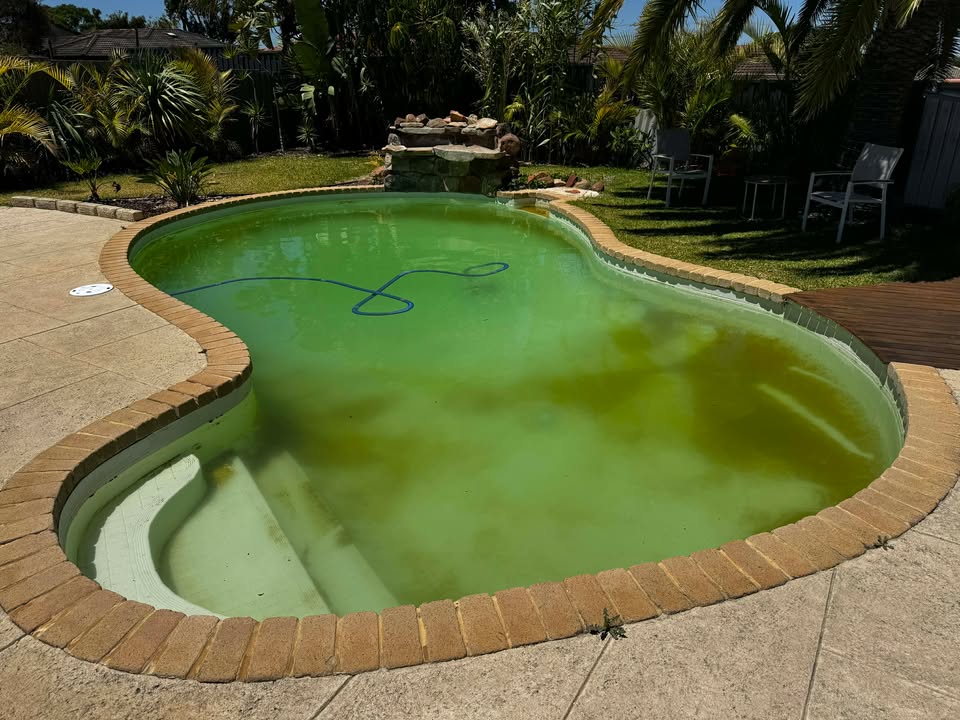
    Green pool in Perth before an Only Pools and Hoses rescue
    A real Perth rescue — day one.

    After 12 years of looking after Perth pools, we can tell you it’s not bad luck. February green pools happen for predictable reasons. Which is good news, because predictable things can be prevented.

    The Perth sun is eating your chlorine

    Chlorine is what keeps algae out of your pool. The problem is that UV light destroys chlorine, and February in Perth is about as UV-heavy as it gets anywhere on Earth. A chlorine level that lasted all week in July can disappear in a day or two in February.

    Warm water makes it worse. Algae grows faster in a 30-degree pool, so you need more chlorine right when the sun is destroying it fastest. It’s a pincer movement, and your pool is in the middle.

    Pumps fail quietly, not loudly

    A pump rarely dies with a bang. More often it loses prime, trips a breaker overnight, or the timer drops its settings after a power blip. The pool looks fine for a few days while the chlorinator does nothing, and then it doesn’t.

    The other quiet killer is run time. Plenty of Perth pools are still on their winter timer settings in February. Four hours a day might be fine in August. In summer, most pools need eight or more. If the water isn’t moving and the chlorinator isn’t running long enough, algae gets a head start.

    The Bali factor

    We call it the classic: two weeks in Bali, came home to a swamp. Nobody was topping up the chlorine, nobody noticed the pump had stopped, and a Perth summer needs about four unsupervised days to turn a pool. Two weeks is plenty.

    What’s actually happening when a pool turns green

    No jargon, promise. Algae spores are always landing in your pool — they blow in on the wind. Chlorine kills them on arrival. When the chlorine runs out, the spores survive, and they multiply fast. One becomes two, two become four, and within a couple of days there are billions.

    That’s why a pool seems to go green overnight. It didn’t. It was going green for days — you just couldn’t see it until the numbers got big enough.

    How to stop it

    • Bump your run time. Eight hours a day minimum through summer, ideally split across the day.
    • Test twice a week. You’re aiming for chlorine of 2–3 parts per million. In February, under 1 is a countdown.
    • Check stabiliser. It’s the sunscreen for your chlorine. Without enough of it, the sun wins.
    • Before you fly out: stand at the pool and watch the pump start on its timer. Then ask a neighbour to glance at the water every few days. A photo text is enough.

    Or put the pool on one of our service plans and make it our problem instead. That’s rather the point of them.

    Already green? Don’t panic

    A green pool looks like a disaster, but it’s almost always fixable. We’ve fixed worse — much worse. Our green pool rescue starts from $450 + GST, and most pools are swim-ready inside 14 days. Many are back sooner.

    One thing we’d say: don’t tip a trolley-load of random chemicals in first. It usually makes our job harder and your bill bigger. A water test before anything else saves everyone grief.

    If your pool’s gone green — or you’d just like it to never happen — give us a call on (08) 6109 9141. The owner answers the phone, and there are no surprises on the invoice. Your pool, sorted.

    Pool gone green?

    We’ve fixed worse. Rescues from $450 + GST, most swim-ready in 14 days.